Here’s to a safe, healthy, and fun 2026!
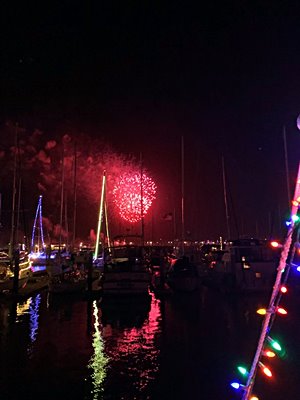
HAPPY NEW YEAR EVERYONE!!!!!
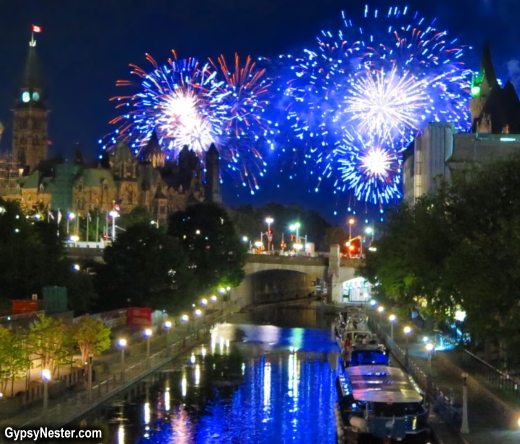
David & Veronica, GypsyNester.com

 ORDER NOW -
Wherever Books Are Sold!
ORDER NOW -
Wherever Books Are Sold!Boomer Travel. Food. Laughter. Breaking the Empty Nest Rules!
Here’s to a safe, healthy, and fun 2026!
CONTINUE READING >>
David & Veronica, GypsyNester.com

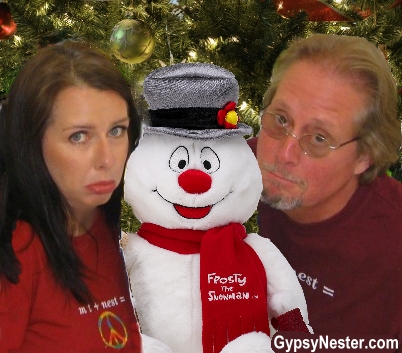
Don’t be sad that the kids have grown and might have holiday celebrations of their own now…
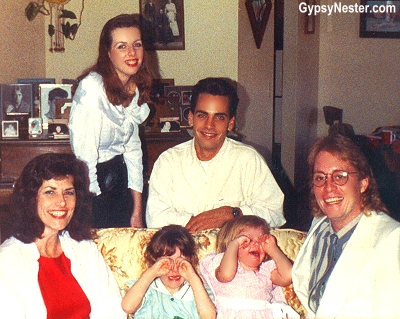 …because sometimes it used to be like this!
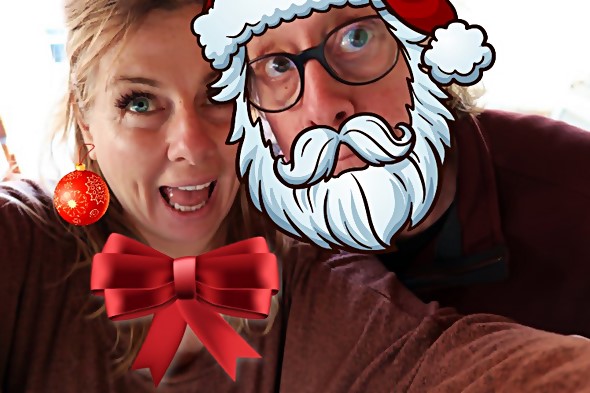
from the Gypsynesters.
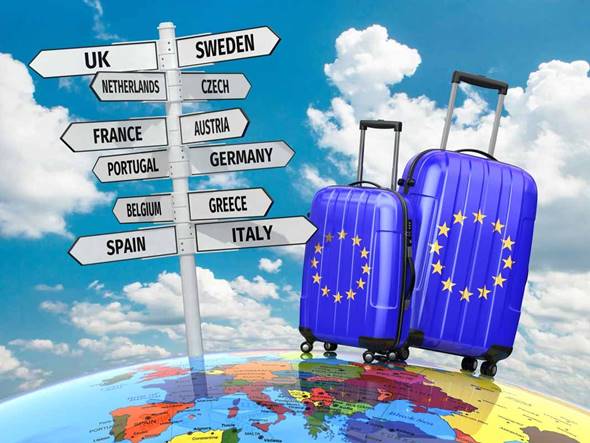 Europe is an incredible travel destination with so much history, diversity, culture, and natural beauty to discover. There are experiences here for every type of traveler and interest… CONTINUE READING >>
Europe is one of the most incredible travel destinations in the world, thanks to its incredible diversity, history, culture, and landscapes. This makes it a great place for travellers with different preferences – there is something for everyone, whether you prefer a capital city steeped in history or a peaceful rural escape. This variety also allows travellers to tailor their vacation to the exact type of experience they want.
Many places in Europe are known for their charming towns, world-class museums, and cultural diversity. If you are seeking a slower pace away from the tourist crowds in the capital cities, you might want to consider coastal retreats, spa escapes, or a lesser-known city break. These trips are ideal for those who enjoy taking in the scenery, history, and local traditions in each destination.
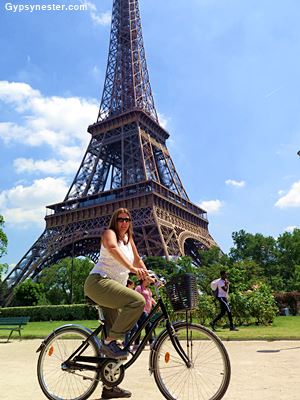
Active vacations are becoming more popular in Europe as they give people the ability to visit multiple places in one trip, enjoy the benefits of hiking/cycling, and see the places between the major destinations – this is where you find the true heart and soul of a destination.
There are all kinds of amazing active adventures to be had throughout Europe, from long-distance cycling routes to mountain treks. Long-distance journeys such as Camino holidays appeal to those who enjoy exploring on foot, with the chance to enjoy a rewarding and iconic pilgrimage. There are other experiences to be had, too, including skiing in the Alps, kayaking in Scandinavia, or hiking the Balkans. The diversity of Europe’s landscapes means it is easy to find an adventure that suits your interests and fitness levels.
With so much to offer and so many places to choose from, planning a European adventure is not always straightforward. This is why it is helpful to think about the pace and experience you want – consider if you enjoy culture, relaxation, adventure, or a mix of everything. This will help you determine your ideal vacation style, whether this is exploring the iconic capital cities, relaxing on a coastal retreat, trekking across Italy, or skiing in the Alps. With so many amazing experiences to be had, it is easy to design a trip once you have established your preferences.
This post should help you plan your perfect European adventure. Europe is an incredible travel destination with so much history, diversity, culture, and natural beauty to discover. There are experiences here for every type of traveler and interest, so you want to make sure that you plan an experience that suits your preferences.
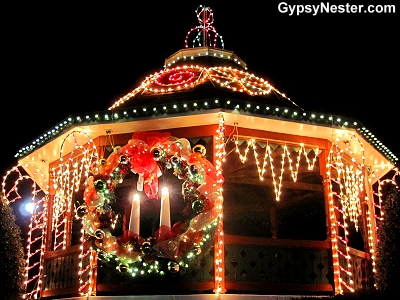 The holidays are fast approaching so now is a good time to explore some of the unique aspects of family gatherings for empty nesters. When we were a young family, the holidays posed a problem for us. Whose family we should visit?
CONTINUE READING >>
The holidays are fast approaching so now is a good time to explore some of the unique aspects of family gatherings for empty nesters.
(A little note from the authors: When we refer to Christmas, please feel free to substitute Hanukkah, Kwanzaa, Festivus, Saturnalia, winter solstice or whatever it is you celebrate. We are only using Christmas as an example because it is our family tradition, and to keep from having to write three or four names every time we refer to a holiday. Absolutely no slight is intended or any preference for one over another. If your family is like ours, no doubt any one of them can be just as crazy as the next.)
When we were a young family, the holidays posed a problem for us. Whose family we should visit? Both sides wanted to spoil their grandkids and have the big family holiday — hard to achieve without feelings getting flogged or feathers being ruffled.
We worked it out by alternating Thanksgivings as much as possible and insisting that we create our own Christmas traditions with our kids in our own home. If extended family wanted to see us they were more than welcome to join in. We haven’t forgotten the limitations that young people face as our own kids attempt to tackle the December Debacles for themselves.
Later on, while we were living on a tiny Caribbean island, the girls attended college in Washington, D.C. and New York City. The physical distance — coupled with the short amount of time they were given off from classes — made it nearly impossible for them to come home for Thanksgiving.
Several times we solved that predicament by getting together at a relative’s house up in the States. That made the trip shorter for the girls and more fun for us because we got to see some of our extended family. Other times our stranded students were fortunate enough to be invited to the house of a friendly family of a friend to join in their Turkey Day celebration.
Christmases were much more conducive to travel with plenty of time between semesters for longer stays. We never had any problems there — who doesn’t want to visit the Caribbean in late December?
Now, if we want to spend a holiday with our grown-up kids, flying everyone from the far corners of the map to wherever we happen to be can get mighty expensive.
We no longer have the benefit of two out of our three offspring living in the same city, but holidays in New York City are becoming the norm. We have had the pleasure of staying in The Piglet ‘s studio apartment when we visit the city and even gobbled up Thanksgiving dinner at Decibel’s humble abode. It’s a tight fit to say the lease, even just for the five of us in the immediate family.
Lately, with the family growing, we have taken to renting an AirB&B outside the city and piling everybody, including extended family of any grandparents, in-laws, or aunts and uncles that can make it. Since we are GypsyNesters and don’t have a home to host a holiday hoedown for Thanksgiving this is a fantastic alternative.
All in all, we have discovered that it really doesn’t matter where you are or what’s on the table, it’s all about being together. One of our best family memories involved a ill-fated trip to Cleveland. Not having planned properly (who? US?), we ended up with three teen-agers stuck in a hotel on Thanksgiving. Not a restaurant was open in the city, so we made a spread out of tortilla chips and beef jerky from the mini mart next door.
An unconventional holiday feast, to be sure, but one that all five of us look back on with fond feelings.
Or perhaps, we’re just weird. Yeah, that’s probably it.
David & Veronica, GypsyNester.com
YOUR TURN: How have the holidays changed for you?
 We love Christmas markets!
 The festivities, the food, the comraderie, the glühwein – put it all together and we’ve got ourselves a great way to ring in the season!
But really — you ask — how different can they be? Surely one Christmas market is the same as the next?
Our reply? Not by a loooooooong shot! … CONTINUE READING >>
We love Christmas markets!
The festivities, the food, the comraderie, the glühwein – put it all together and we’ve got ourselves a great way to ring in the season!
But really — you ask — how different can they be? Surely one Christmas market is the same as the next?
Our reply? Not by a loooooooong shot!
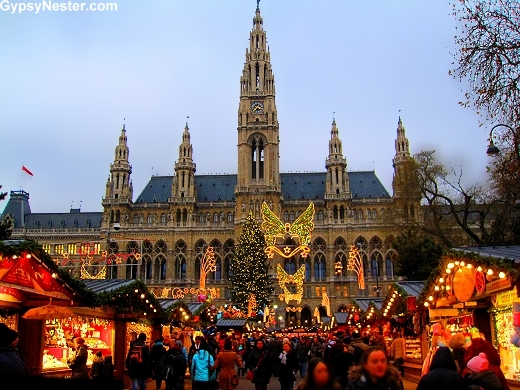
Arguably the oldest of the markets, the Vienna December advent market was the predecessor to the modern Christkindlmarkets, or Christ child markets, and is said to have started way back in 1294.
The idea spread across the Holy Roman Empire, and they remain most popular in the German-speaking regions of Europe.
As with most of the cities we have visited there are several markets scattered about town, but the Wiener Christkindlmarkt in the Rathausplatz, the plaza in front of the town hall, is the city’s main market.
We were thrilled to wander through the descendant of the world’s first.
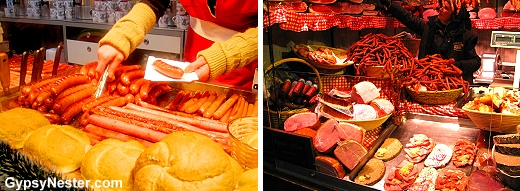
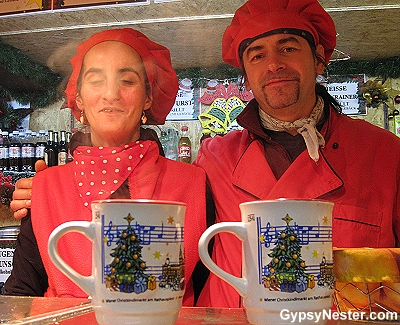
Local delicacies are a big part of experiencing the markets, so of course we had to sample some from the selection of sausages, (that makes them Vienna sausages, right?) and a steaming cup of mulled wine known as glühwein.
The name is said to come from a glowing hot iron used to warm the wine, or maybe it’s because this staple at the markets really hits the spot when it comes to keeping the shoppers warm and glowing.
See more photos of the Vienna Christmas Market!
See our entire adventure in Vienna
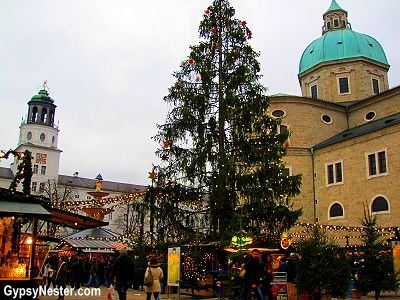
While not the oldest, like its Austrian neighbor, Salzburg has perhaps the biggest and best Christmas market we’ve visited in the country.
Food and drink are certainly available, but this market has much more to offer in the way of local crafts and unique gift items.
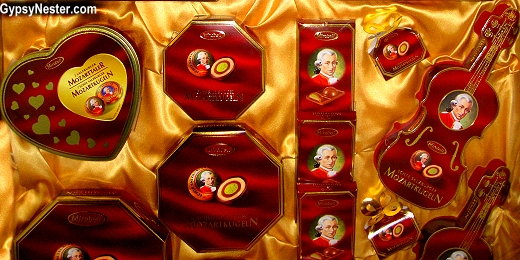
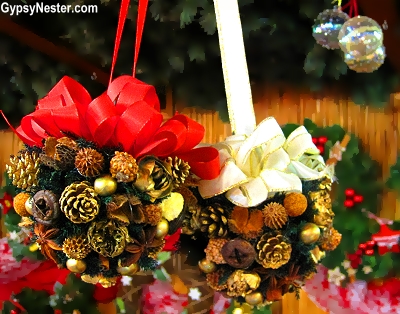
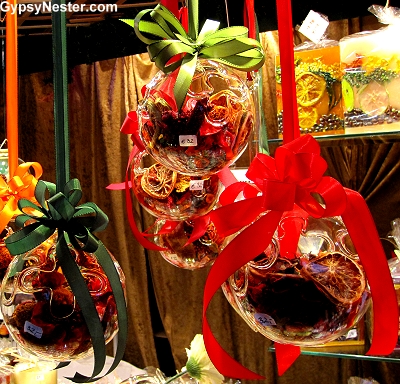
In addition to the city’s famous Mozart chocolates, we bought a gewürzstrauss, the traditional spice bouquet that makes anyplace smell like Christmas.
See our entire adventure in Salzburg!
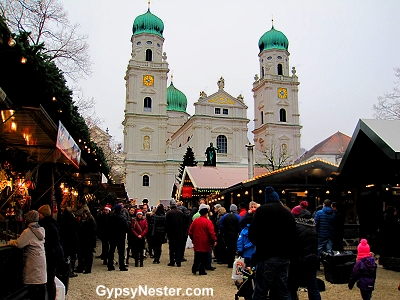
In Germany we visited the Passau Christmas market at the square in front of St. Stephen’s Cathedral, a baroque church from 1688.
Here we discovered something new and truly inspired, the half-meter würst.
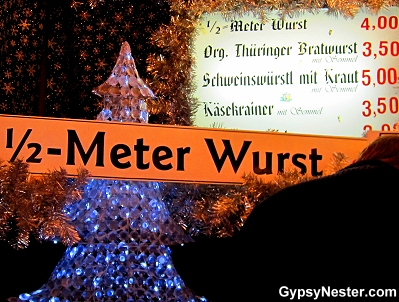
Wow, that’s nearly two feet of sausage!
Did we (meaning David) die and go to heaven?
Unfortunately we had just eaten a huge lunch, so we had no place to put half a meter of würstle.
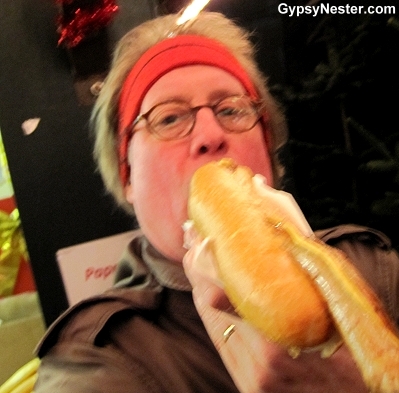
That minor detail was easily overcome when Sausage Boy devised a würst-case scenario, and snuck his way back a little later to partake of the best of the würst, or at least the biggest.
Sometimes he can be his own würst enemy.
The quest culminated in a legendary half-meter-würst selfie.
See more photos of the Passau Christmas Market and the full story of the infamous würst!
See our entire adventure in Passau!
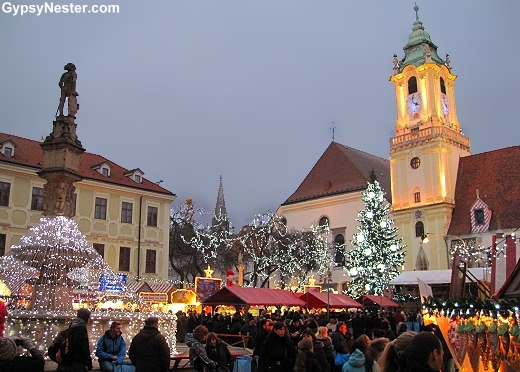
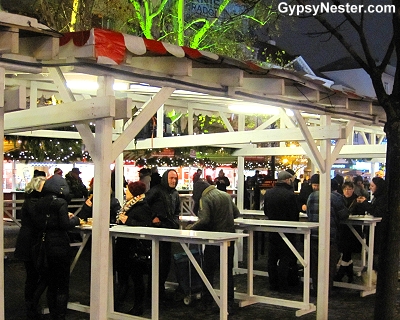
While the markets are most common in the German speaking world, we also found a fun example in Bratislava, Slovakia.
The Hlavne namestie, or main square, was filled with vendors, mostly selling food and drink, and tables under small shelters where the purchases could be enjoyed.
A very social situation and we were more than happy to jump into the middle of it.
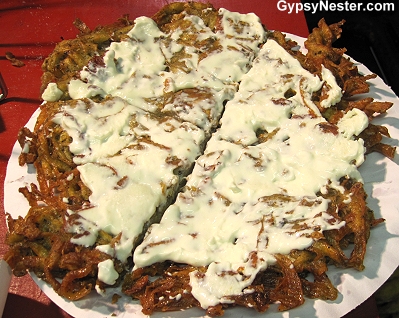
We gave zemiakové placky with cheese a try. This is a pancake made of shredded potatoes — crisp on the outside and chewy within — covered in a layer of mild, yet tangy white sheep cheese.
We gave it two gloved thumbs up, very tasty and stick-to-your-ribs on a chilly December evening.
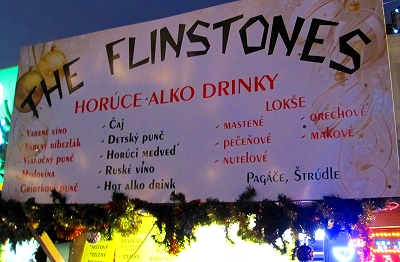
Nearly everyone warmed themselves with varene vino, the local version of mulled wine, but in a twist we hadn’t seen before, hot white wine seemed just as popular as the red.
After giving this regional variety a try, our verdict was that while delicious, it lacked the superior cockle-warming qualities of the red. But the fact that we made our purchase from a vino vender named “The Flinstones” more than made up for it.
Yaba-daba-do (we think)!?!
See more photos of the Bratislava Christmas Market!
See our entire adventure in Bratislava
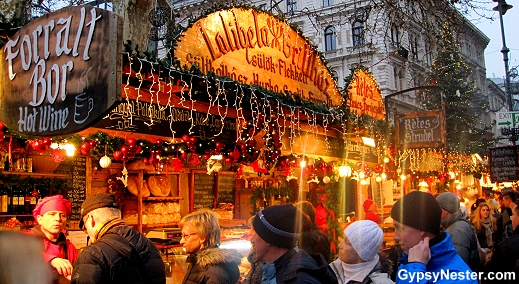
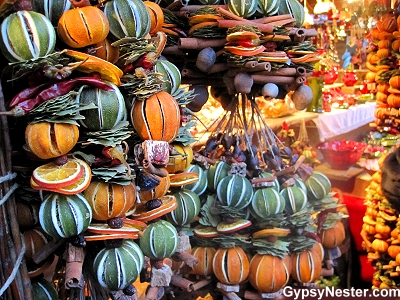
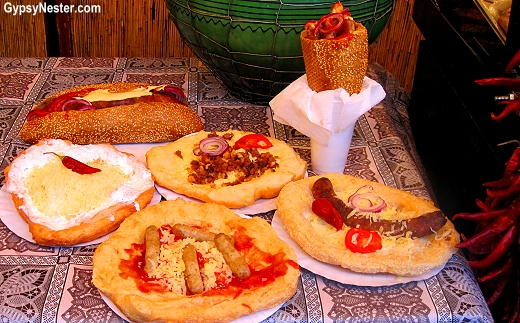
In Budapest, food also stole the spotlight.
On the Pest side of the city we checked out the main Christmas market, a large collection of stands and kiosks all decked out in holiday style.
While there were plenty of booths selling handcrafted gifts, food — lots of food — was certainly the main event.
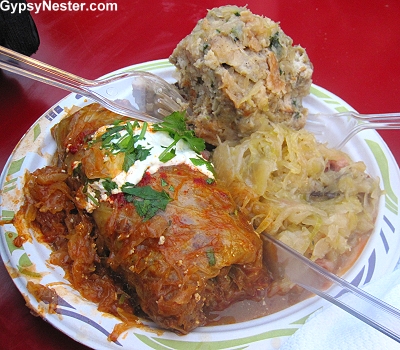
After scouting out all the offerings we ordered a töltött káposzta, that’s cabbage stuffed with meat and rice, served with a paprika sauce and sour cream.
Exceedingly Hungarian!
We also couldn’t resist a huge smoked meat dumpling with sauerkraut.
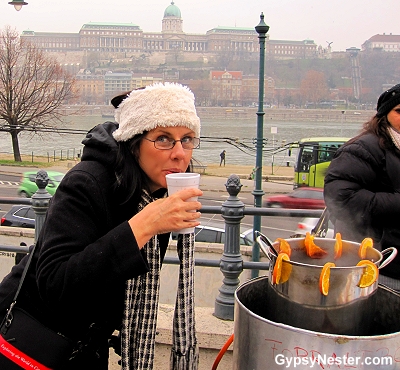
To wash it all down, and to stay warm too, we tried the Hungarian version of glühwein, which is called forralt bor, meaning simply “boiled wine.”
See more photos of Budapest’s bustling Christmas Market!
See our entire adventure in Budapest
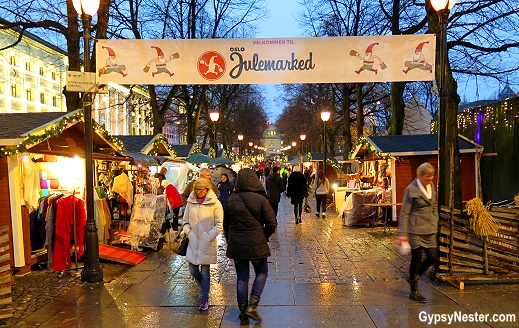
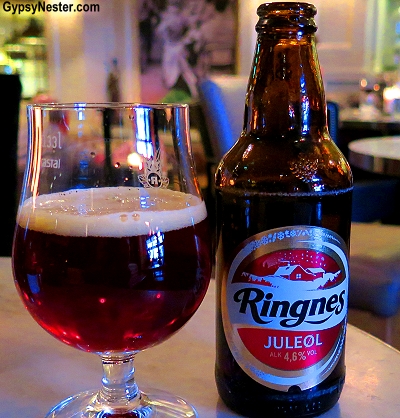
On our recent crazy romp across Norway up to the Arctic Circle by train, we found the Scandinavian equivalent to a Christkindlmarkt, a Julmarked, in Oslo.
The Jul, or Yule, celebration predates Christianity but, since it coincides with Christmas, the two have become intertwined.
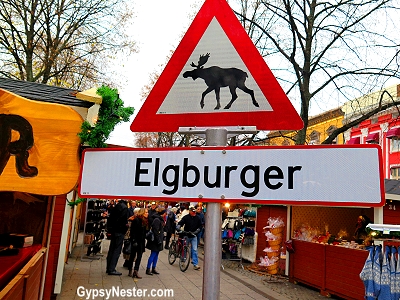
The Norwegian market was very similar to the others we’d seen, with the exception of the preponderance of elk and reindeer based products.
Plus, what they were calling elk, or more precisely elg, sure looked like moose to us, and we all know they don’t really exist.
Flying reindeer, sure, but moose?
No way. (Well, maybe we were wrong.)
See all of our adventures in Norway!
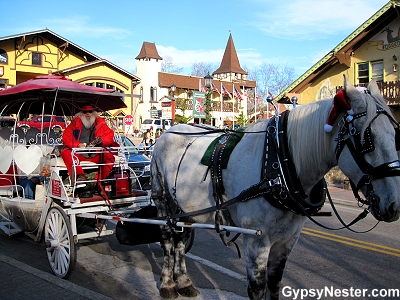
While these European markets all have long histories behind them, the custom has spread far and wide.
Christmas markets are even becoming commonplace throughout the United States.
In fact, the first one we ever visited was a few years ago in the mountains of northern Georgia at the town of Helen.
Their Christkindlmarkt is in keeping with the town’s reincarnation as an alpine Bavarian village.
It was only natural that this nearly perfect reproduction of a German town would also feature this seasonal tradition.
See our entire adventure in Helen, Georgia
New York City also hosts a number of Christmas markets throughout the city. Two of the biggest and most popular are the Winter Village at Bryant Park, and the Union Square Holiday Market.
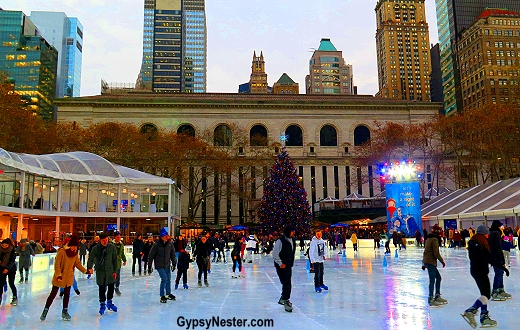
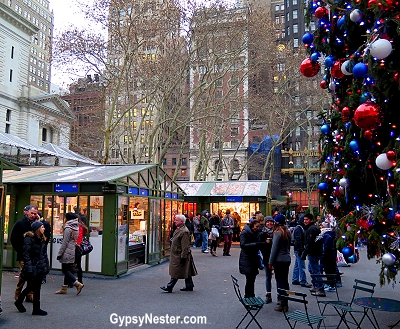
Surrounded by soaring skyscrapers, Bryant Park’s Winter Village began in 2002.
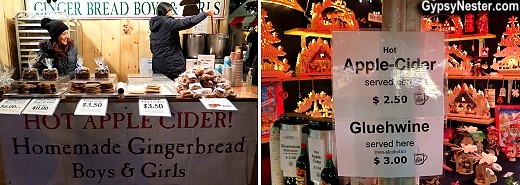
Booths offer NYCcentric wares and food (we saw everything from chimney cakes to sushi), and in lieu of glühwein, New York apple cider is standard fare.
Bryant Park boasts a huge Christmas tree and a full-sized ice skating rink that’s twice as big as the rink at Rockefeller Center — and it’s free to skate!
The Union Square Holiday Market may not be quite as spectacular, but it struck us as more traditional.
A veritable maze of tents are set up offering all kinds of gifts and goodies that are sure to put even the Ginchiest Grinch in the spirit of the season.
See 10 things you don’t know about NYC!
See all of our adventures in New York!
David & Veronica, GypsyNester.com
YOUR TURN: Are you game to give a Christmas market a go? Have you been to a Christkindlmarkt? Tell us all about it below!
 These magnificent animals have traveled thousands of miles to be here, and you have the privilege of witnessing their journey. The humpback whales of Maui are waiting. All you need to do is show up, pay attention, and let these incredible creatures remind you of the wonder that still exists in our world… CONTINUE READING >>
Have you ever wondered what it’s like to witness a 40-ton humpback whale breach the surface just yards from your boat? Last winter, I found myself standing on the deck of a whale watching vessel off Maui’s coast when suddenly, without warning, a massive humpback launched itself completely out of the water. The sound of its body crashing back into the ocean was like thunder, and in that moment, I understood why thousands of travelers flock to Maui every winter for this extraordinary natural phenomenon.
If you’re planning a winter escape to Maui and want to experience one of nature’s most spectacular shows, you’re in for something truly special. By the end of this guide, you’ll know exactly when to go, what to bring, how to choose the right tour, and the ethical considerations that make this experience meaningful for both you and these magnificent creatures.
Between November and May each year, thousands of North Pacific humpback whales make an incredible 3,000-mile journey from Alaska’s cold feeding grounds to Hawaii’s warm waters. They come here for two primary reasons: to give birth and to mate. What makes Maui particularly special is the shallow, protected channel between Maui, Lanai, and Molokai, known as the Auau Channel.
During peak season, an estimated 10,000 to 12,000 humpback whales populate Hawaiian waters, with the highest concentration found right here in Maui County. This represents about two-thirds of the entire North Pacific humpback whale population. When you’re whale watching in Maui during winter, you’re witnessing one of the largest gatherings of these animals anywhere on Earth.
What I’ve found most fascinating is that these whales don’t eat during their entire stay in Hawaiian waters. They survive entirely on fat reserves built up during summer feeding in Alaska. Every breach, every tail slap, every song they sing is powered by stored energy, making their displays of strength even more impressive.
Here’s something most people don’t realize about whale watching in Maui: timing isn’t just about picking the right month, it’s about understanding the whales’ behavior patterns throughout the season.
This is when Maui’s waters transform into a humpback whale nursery. January through March represents the absolute peak of whale watching season, with February being the single best month. During my February visits, I’ve counted dozens of whales visible from shore on any given day. The pregnant females have arrived and given birth, so you’ll see mothers with newborn calves. The males are actively competing for female attention, which means more surface activity, breaching, tail slapping, and pectoral fin slapping.
November-December offers quieter experiences with fewer crowds but less whale activity. April-May features calves practicing breaching and calmer seas, though whale numbers decline. If you value intimacy over abundance, these shoulder seasons work beautifully.
Morning tours (7:00-10:00 AM) typically offer calmer seas and better visibility. The sun angle is more favorable for photography and viewing. That said, I’ve had incredible afternoon encounters when the whales seemed particularly active. Whales don’t follow a strict schedule.
This might surprise you, but binoculars are absolutely essential for whale watching. Federal law requires boats to maintain a 100-yard distance from humpback whales. While whales can approach boats, you can’t approach them. Binoculars allow you to observe whales at a distance without disturbing them.
I recommend 7×50 or 8×42 binoculars for whale watching. These specifications provide a good balance of magnification and light-gathering ability while maintaining a wide field of view, critical when you’re on a moving boat tracking moving whales. Avoid anything higher than 10x magnification; the image shake makes them nearly impossible to use effectively.
The Hawaiian sun is intense and amplified by reflection off the water. You need:
Photographing whales is challenging. They’re unpredictable and fast-moving. Use burst mode on your phone or a camera with fast shutter speed (at least 1/1000 second). The most important advice: don’t experience the entire trip through a viewfinder. Take some photos, but spend most of your time simply watching. The memories you create will be more vivid than any photograph.
Learning to interpret whale behavior transforms your experience from simple sightseeing to genuine understanding.
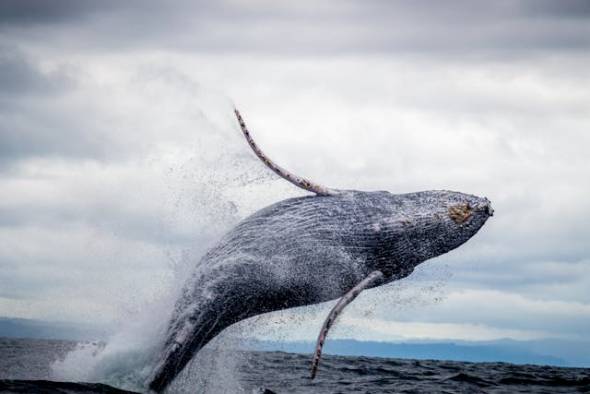
Breaching is when a whale launches itself almost completely out of the water. Scientists believe it serves multiple purposes: communication (the sound travels miles underwater), removing parasites, and possibly just for fun. Breaching often occurs in clusters, if you see one whale breach, watch carefully because others nearby often follow.
Tail slapping creates a thunderous sound and is often a sign of agitation or warning. Pectoral fin slapping involves those massive 15-foot fins repeatedly hitting the water’s surface. Spy hopping is when a whale rises vertically to look around above water, they’re literally checking out their surroundings.
Competitive pods are multiple male whales aggressively competing for access to a female. These encounters can be dramatic, with whales charging and breaching. This is some of the most dynamic whale behavior you can observe.
This is where whale watching becomes more than entertainment, it becomes conservation in action.
Under the Marine Mammal Protection Act, vessels must maintain a minimum distance of 100 yards (300 feet) from humpback whales. This isn’t a suggestion, it’s federal law with significant penalties for violations. If a whale approaches closer, vessels must put engines in neutral and allow the whale to pass.
For drones and aircraft, the minimum altitude is 1,000 feet.
Humpback whales come to Hawaii to rest, give birth, and nurse their young. They’re not feeding, so they’re operating on limited energy reserves. Disturbance from boats can cause stress, interrupt nursing, separate mothers from calves, and force whales to expend precious energy avoiding vessels.
Research shows that repeated disturbance can cause whales to abandon preferred habitats. If Maui’s waters become too stressful, whales might choose different locations, catastrophic for both the whales and Maui’s whale watching industry.
Here’s something that might surprise you: responsible whale watching actually contributes to conservation. When done ethically, it creates economic value for living whales, incentivizing protection. The North Pacific humpback population has recovered from fewer than 1,500 in the 1960s to over 20,000 today, one of conservation’s great success stories.
Not all whale watching experiences are created equal.
Mid-sized boats (40-60 passengers) often provide the best balance of stability and intimacy. Larger boats offer more amenities and stability but can feel crowded. Smaller boats provide intimate experiences but more motion.
A whale watching tour without expert interpretation is like visiting a museum without labels. Naturalists can identify individual whales, explain behaviors in real-time, and answer questions. This educational component transforms the experience from sightseeing to genuine understanding.
Tour companies such as Pride of Maui run seasonal whale watches with naturalist commentary on vessels that offer both stability and expert interpretation.
Most tours depart from Maalaea Harbor (shortest travel time to prime areas) or Lahaina Harbor (convenient for West Maui). Standard tours run 2-3 hours, generally sufficient to see whales and observe various behaviors. Reputable operators offer whale sighting guarantees during peak season.
You don’t need a boat tour to see whales in Maui. During peak season, whales are frequently visible from shore.
Papawai Point (McGregor Point) along the Pali Highway offers elevated views of the channel. I’ve spent hours here with binoculars watching whales breach and blow. Wailea Beach Walk provides multiple vantage points with unobstructed ocean views. Kapalua Coastal Trail combines hiking with whale watching opportunities.
When scanning from shore, look for blows (spray from blowholes), breaches, tail flukes, and unusual water disturbances. Shore-based whale watching requires more patience but offers its own rewards: no time limits, no crowds, no seasickness, and it’s completely free.
Book 2-3 weeks in advance during peak season (January-March). Popular operators sell out quickly, especially for morning departures. Tours typically range from $50-$150 per person depending on boat size and duration.
Winter is Hawaii’s rainy season, but rain rarely prevents tours. High winds and large swells can cause cancellations, but this is relatively uncommon. Don’t be overly concerned about light rain, whales don’t mind it, and neither should you.
Manage expectations. Whales are wild animals. Some days feature spectacular surface activity; other days bring quieter behaviors. Both experiences are valuable, one is exciting, the other peaceful and contemplative.
Be present. Put down your phone periodically and simply watch. Notice the barnacles on a whale’s skin, the rainbow in the mist from a blow, the way water streams off a breaching whale’s body. These details create memories that photographs can’t capture.
Ask questions. If your tour includes a naturalist, take advantage of their expertise. The more you understand about what you’re witnessing, the more meaningful the experience becomes.
There’s something profound about watching humpback whales that goes beyond entertainment. These animals represent one of conservation’s greatest success stories. They were hunted to the brink of extinction, with populations reduced by more than 90%. The decision to protect them allowed their populations to recover.
Every whale you see is a descendant of the few thousand that survived commercial whaling. Their recovery is testament to what’s possible when we choose protection over exploitation. This context transforms whale watching from simple tourism into something more meaningful, a celebration of conservation success and a reminder of our responsibility to protect the natural world.
Winter in Maui offers the opportunity to witness one of nature’s most spectacular phenomena in one of the world’s most beautiful settings. Visit between January and March for peak activity, bring quality binoculars, choose operators who prioritize ethics and education, respect approach distances, and most importantly, be present in the moment.
These magnificent animals have traveled thousands of miles to be here, and you have the privilege of witnessing their journey. The humpback whales of Maui are waiting. All you need to do is show up, pay attention, and let these incredible creatures remind you of the wonder that still exists in our world.

Last year, in our post-turkey bloat, we grabbed the remote and settled into something we rarely do. We vegged in front of the boob-tube. Immediately we felt bombarded.
The blaring onslaught of Black Friday ads was funny at first, but after an hour or so, being yelled at to BUY! BUY! BUY! the commercials didn’t seem so funny anymore…

We saw this quote and just had to share. It struck us that we may be losing sight on what is truly important this holiday season.
Christmas Gift Suggestions
To your enemy, forgiveness.
To an opponent, tolerance.
To a friend, your heart.
To a customer, service.
To all, charity.
To every child, a good example.
To yourself, respect.
-Oren Arnold
Last year, in our post-turkey bloat, we grabbed the remote and settled into something we rarely do. We vegged in front of the boob-tube.
Immediately we felt bombarded. The blaring onslaught of Black Friday ads was funny at first. We sat and mocked in our usual GypsyNester fashion.
But after an hour or so, being yelled at to BUY! BUY! BUY! the commercials didn’t seem so funny anymore.
They had become insulting and irritating.
In fact there’s no waiting until Friday anymore, we were right in the midst of what seemed to be the first Black Thanksgiving. Stores are now opening up on Thursday night for their “Friday” sales!
The evening news carried a segment with “professional shoppers” bestowing tips on how to survive Black Friday. One ad had the gall to suggest that Black Friday was the day of the year we should be looking forward to most.
It seems every year we hear the horror stories of folks — in a frenzy to buy the hottest items at the lowest price — camping out on freezing sidewalks, coming to blows with their neighbors, and being trampled by fellow shoppers.
We doubt this year will be different. Except that now it starts right after Thanksgiving dinner… or maybe even before.
Trust us, we will not be a part of it.
Now get off my lawn.
David & Veronica, GypsyNester.com
YOUR TURN: You’ve heard our rant. How do YOU feel about Black Friday? Do you brave the crowds?